
Where Old Maryland Mugshots May Survive
Who kept the record matters most. An old Maryland booking photo was created or received by a specific government agency. That may be a police department, sheriff, detention agency, or court. The file may still be there. Or it may have moved under an approved transfer schedule, or been destroyed. A name found in a prison register can confirm a correctional record existed. But it cannot prove the photo was kept.
Think of the Maryland State Archives as a map, not a warehouse. Its finding aids describe record series. They point to material held by the Archives, agencies, counties, and municipalities. Not every old arrest record was transferred, scanned, or preserved. Maryland has no single public archive for old mugshots. Match your terms to the record you want. A prisoner register, a commitment record, a court case file, and a booking photo are related. But they are distinct items. Ask for a photograph by name. Ask the originating agency whether its schedule transferred or destroyed that photo series. That one question saves a lot of dead ends.
Maryland State Archives Finding Aids
Start with the Archives' approved-schedules page. It lists state, county, and municipal schedules. Each schedule names a record series and says how long it is kept before transfer or destruction. Schedules can also be superseded, so check for the current version. For county records, the S1521 county-schedule guide is a good starting point.
These tools track retention and transfer. They are not catalogs of individual arrests. Match the record's likely creator and period to a series name. Then check the guide for dates, formats, and access details. Some archival material is physical only. Some digitized items cover just part of a series. A finding aid can point you to the right place even when it holds no photo or file itself.
The Archives describes the Maryland House of Correction Prisoners Record, S253 as a series of prisoner information. It is not a guaranteed photo set.
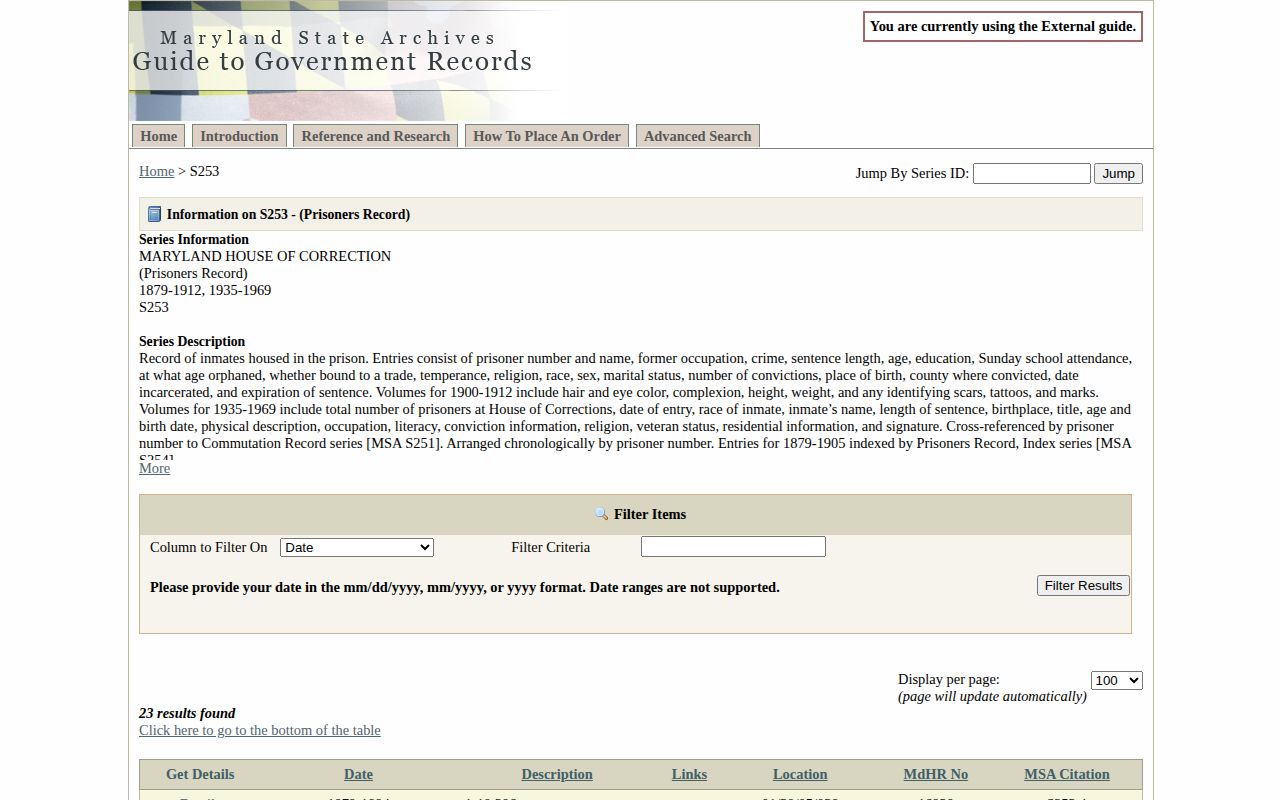
S253 can lead you to historic prisoner entries. An entry in a register is not a booking photo, so confirm the format and contents before requesting a copy. Labels matter here. Note: Finding aids identify records and transfers, but they do not promise that a particular arrest photo survived or was digitized.
S253, SE65, and S277 Records
Three Maryland correctional series offer strong leads. The House of Correction series S253 covers two periods, 1879–1912 and 1935–1969. Its fields include names, prisoner numbers, crime and sentence data, and physical descriptions. The Penitentiary's SE65 reaches further. That series spans the nineteenth century into the modern era. It records physical descriptions, distinguishing marks, sentences, and release details. Digitized PDFs exist for portions of SE65, not the whole series.
The Penitentiary prisoner index, S277, runs from 1840 to 1906. It helps find an index entry. An index hit is not the full record. Verify related series and item details with the Archives first. A series description tells you what the Archives says is present. It does not confirm a booking photograph is included.
The SE65 finding aid describes the historic Penitentiary records and links the digitized portions. Treat it as a research aid.
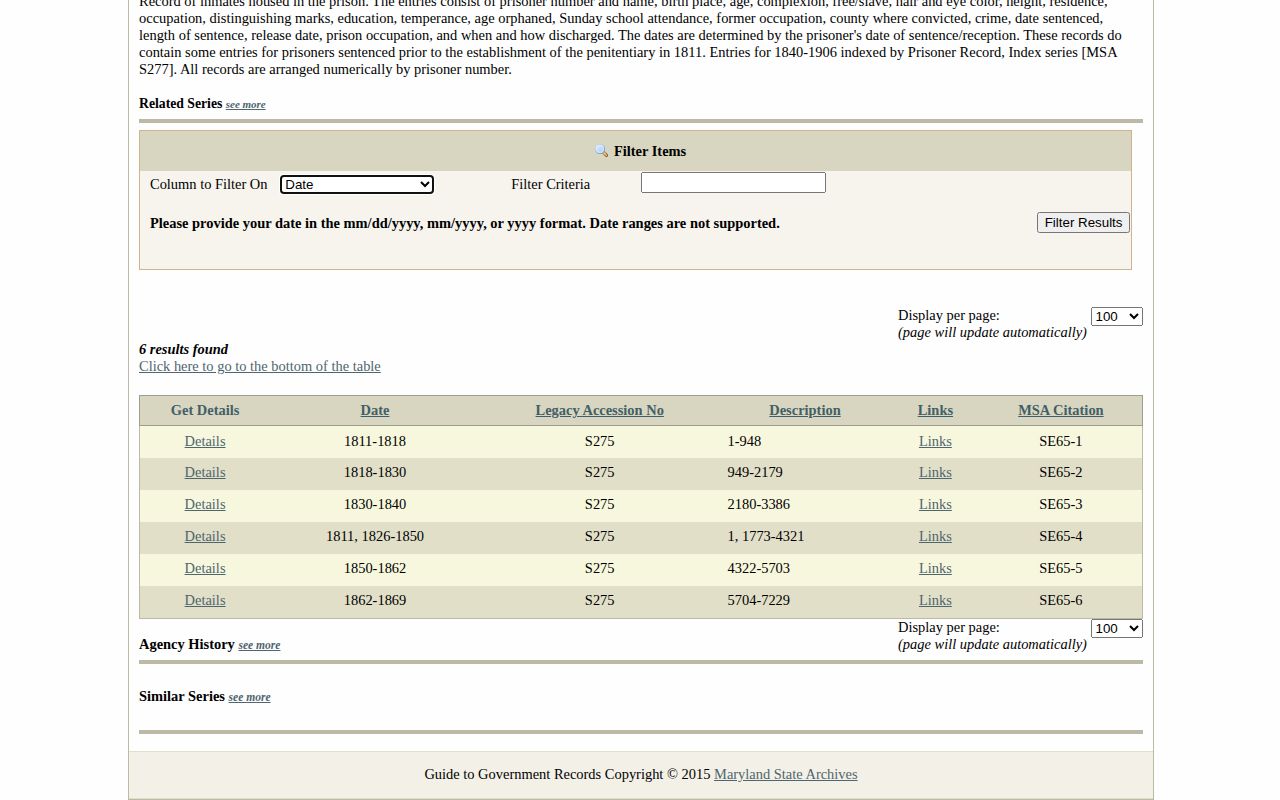
Use the S277 index guide for its 1840–1906 range. Verify any related series and item details with the Archives. A result can yield a name or sentence record, though not a photograph.
| Series | Period in the guide | What it can help locate | Photo caution |
|---|---|---|---|
| House of Correction Prisoners Record, S253 | 1879–1912 and 1935–1969 | Names, prisoner numbers, crime or sentence information, physical descriptions | The series description does not establish a booking-photo collection |
| Penitentiary Prisoner Record, SE65 | Nineteenth century into the modern era | Physical descriptions, distinguishing marks, sentence and release details; PDFs for portions | Digitized portions do not mean all records or images are online |
| Penitentiary prisoner index, S277 | 1840–1906 | An index path for names in the period covered | An index entry is not itself proof that a photo survives |
Retention Schedules and Photo Survival
Maryland sets its retention rules agency by agency. Each schedule lists a series, its retention period, and its fate. Some records get transferred. Others are destroyed. A statewide retention-schedule list can point you toward the right rule. But a transfer entry doesn't put an image online. A long period doesn't guarantee public search access either, nor that every item in a series survives.
Howard County Police offers one concrete example. Its schedule names arrest photographs and moves them to a photo CD. Once the transfer succeeds, the paper record is destroyed. The CD is destroyed 80 years after the arrest. That figure is one agency's rule. It does not apply to every Maryland agency, and it says nothing about photos staying viewable online for eight decades.
Before requesting anything, check the Archives retention-schedule information alongside the agency's own schedule. Ask whether the record should still exist and whether it was transferred. If the schedule was updated, work from the current approved version. An old online roster proves nothing about permanent public retention. A missing web result, likewise, proves nothing about destruction.
Note: Howard's 80-year photo-CD rule covers one county police schedule, not a Maryland-wide online retention period.
When an agency reports a transfer, request the series name and any reference details. That information keeps the search moving. When no transfer is documented, ask the office to confirm its current retention rule and whether the item was destroyed under it.
Requesting Maryland Archival Records
The Maryland State Archives lays out its offerings on a services page. It covers appointments, helpdesk assistance, research help, image orders, and fees. Its orders page accepts requests by mail, email, or fax. Staff search best with a full name, jurisdiction, court, year, charge, and case number. Correctional series add more tools. A prisoner's number helps. So do the institution and a rough commitment or release period, when known.
Name the record, not the person's entire file. If a photograph is the goal, say so plainly. Include the agency or institution and likely record type. Add the time period and any series or case reference already found. Clarify that no register substitute is wanted as a mugshot. Then ask whether the Archives holds it. Ask whether the agency still keeps it. Ask whether a digital copy exists or an image order is required.
- Identify the likely creating police, sheriff, jail, court, or correctional institution and the approximate year or era.
- Search the Archives Guide to Government Records for the agency, series name, and transfer or retention details.
- Use the series guide to note the date span, box or item reference, format, and any stated access limits.
- Submit a targeted order through the Archives' listed mail, email, or fax route, with the full name, jurisdiction, year, charge, and case number when known.
- Review the current fee schedule and ask about the expected process before ordering a copy or image.
The Archives' fee schedule covers general research and copy charges, criminal case-file folders, digital images, specialized research, and onsite copies. Costs vary by service and item. Check the schedule before ordering. The services page quotes two to four weeks for image orders. That timing covers images only. Treat it as no promise for every request.
Baltimore City records follow a different path. The Baltimore City Archives posts its own appointment, research, scanning, and copying terms. Its service and fee page governs that city's archival work. Don't apply another agency's costs there. Separately, the statewide Archives' file-request page serves agency records management. It is not a public patron order form.
Note: the two-to-four-week period applies to Archives image orders, not to every records or research request.
Recent Arrests and Older Records
Recent custody data and archival records travel separate roads. A current county roster or arrest log sits with a local agency. Or it sits with a service provider. A historic prison series is identified through an Archives finding aid. A booking photo request goes to whichever office created or kept the image. County systems offer no single statewide history. Nor does the Maryland State Archives promise that every local booking photo has been transferred.
For a newer event, contact the county or city agency first. Ask which office holds the booking record and photograph. The Maryland County Directory routes you to local jurisdictions. For a statewide view of current search channels, the Maryland arrest and mugshot source guide helps. Both routes point to today's custodian. The Archives guide handles records already inside a historical series.
Older events start with the creating agency. Ask whether it still holds the record and which schedule applies. If the record transferred, follow the series guide and its item references. Found a related register? Confirm the actual format includes a photograph before ordering. A record may preserve a description or sentence. The booking image may never have entered that series.
What may survive: prisoner indexes, registers, sentence and release details, agency files, court records, or a specific image series. What is not assured: a mugshot for every arrest, a statewide archive, a complete digitized set, or an image still online. Old photos depend on the custodian, not one database.
Old Maryland mugshots are a record-search question with several possible custodians, not a single website lookup. Name the person, jurisdiction, agency or prison, time period, and exact record. Then follow the documented transfer path.