
How Maryland Busted Wanted Notices Work
Every Maryland wanted notice belongs to an agency. That agency decides who appears. It also sets what details the public sees. A wanted page is a hand-picked notice, not a statewide register of every active warrant. Expect a name and the alleged offense. Warrant details, a description, a photo, and the investigating agency's tip request round it out. A photo can predate the notice. It may come from an ID record rather than a booking event.
The Maryland Coordination and Analysis Center's Most Wanted Criminals by Agency is the statewide doorway to participating department lists. MCAC links out. The agency cautions that each linked list is maintained elsewhere. A hub like this helps you find a department's own notice. It cannot promise that every county participates, that lists stay current, or that all open warrants appear. Confirm with the issuing agency before relying on a notice.
No public page in Maryland merges these into one view. County booking photos, local wanted notices, parole matters, and federal fugitives stay separate. These systems answer different questions. A custody locator tells you who is held now, not who is being sought. A court docket shows case events. It does not tell you whether a warrant still stands. The statewide Maryland booking and roster guide walks through how these record systems differ.
How to Read a Maryland Wanted Notice
- Confirm the issuing department and open the notice on that agency’s own site.
- Read the displayed date, case reference, alleged offense, and tip instructions; not every agency publishes every field.
- Use the official contact to ask whether the person is still sought. An online capture or search result can lag behind a change in status.
- Send information to the agency without approaching, following, or publicly identifying anyone you believe you recognize.
The official DPSCS Division of Parole and Probation Most Wanted Violators route is an agency route. It returns a database error. Treat it as a documented agency route worth retrying, not a working list. DPSCS publishes no independently verifiable public absconder photo list. Don't trust a stale cached page as current status. For comparison, the MCAC agency navigation page organizes wanted information by department. It is not one statewide roster.
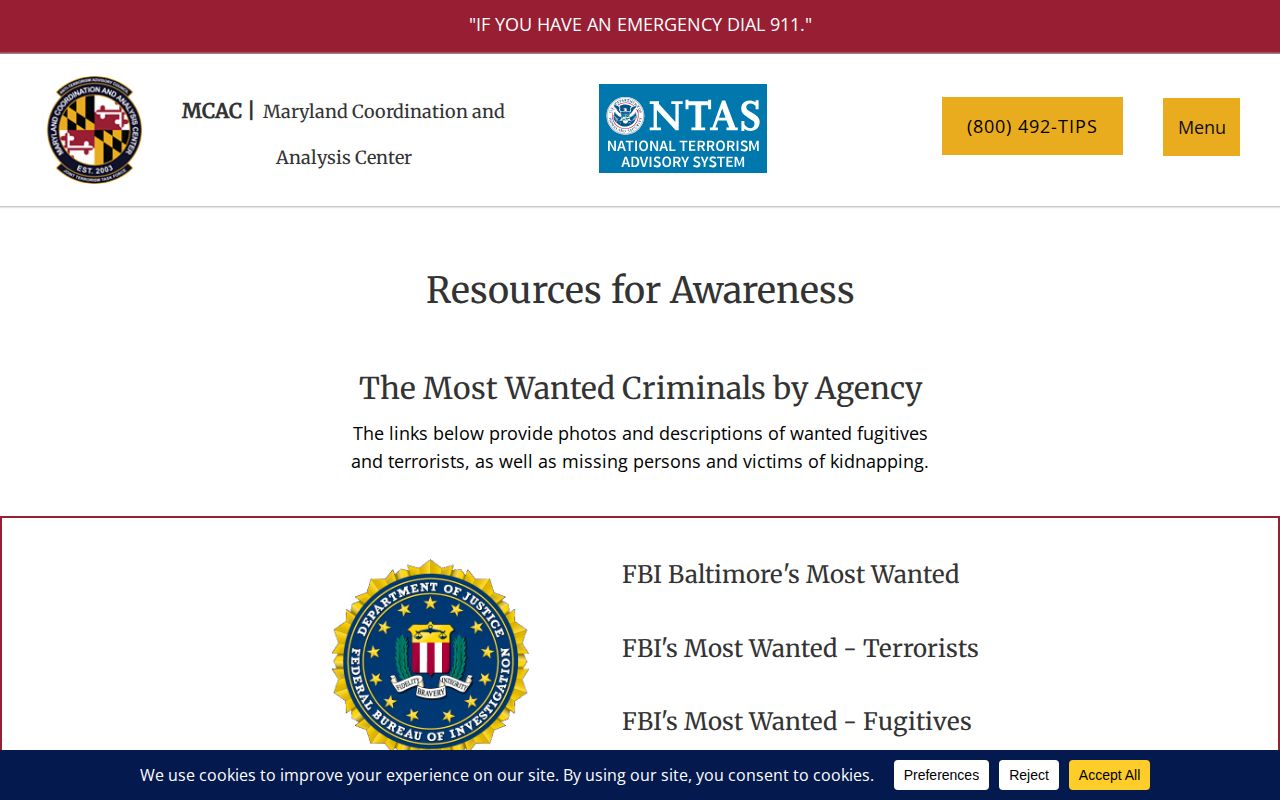
Agency-based navigation means each department controls its own photos, descriptions, statuses, and contact instructions. Check with the agency before acting on a notice or sharing it as current.
Maryland Busted: State and Federal Wanted Sources
These statewide entry points differ in scope and availability. "Photos possible" only means an agency may show an image on a given notice. It promises neither a photo for every entry nor a booking photograph.
| Source | Who runs it | Photo/status notes | Official location |
|---|---|---|---|
| Most Wanted Criminals by Agency | Maryland Coordination and Analysis Center | Routes to participating agencies; linked entries may include a wanted photo and tip instructions. Check the agency page for updates. | MCAC wanted hub |
| Most Wanted Violators route | DPSCS, Division of Parole and Probation | The official route returned a database error during review; a current public list was not verified. | DPP route |
| District of Maryland | U.S. Marshals Service | Federal fugitive profiles may include photos. This is not a Maryland jail roster or a full federal warrant search. | USMS district page |
| County and municipal wanted notices | Local sheriffs and police agencies | Separate local pages can include names, descriptions, photos, and agency-specific contacts. Coverage and update practices vary. | Use the county directory to locate local agency sites. |
Details a Wanted Entry May Include
| Field | How to interpret it | What it does not prove |
|---|---|---|
| Name or alias | The name the agency associates with its notice. | A name match alone does not establish identity. |
| Photograph or description | An image or physical description supplied for identification. | The image may not be a booking photo, and likeness is not confirmation. |
| Charge or alleged offense | The charge or case label tied to the notice. | It is not a conviction or a complete statement of the court record. |
| Warrant/case reference | A clue for the issuing agency or court to locate the matter. | A visible reference does not confirm that the warrant remains active. |
| Agency and tip channel | The office responsible for the notice and its preferred way to receive information. | It does not authorize a member of the public to investigate or intervene. |
| Date or status note | When the page says it was issued, updated, or reviewed. | A missing or old date does not establish present status. |
MCAC is the clearest statewide starting point. It is not a completeness guarantee. No working statewide public DOC absconder listing exists. A state agency route can exist while its public interface stays down. That gap matters when you need present status. A historical lead is a different question.
The U.S. Marshals Service District of Maryland handles federal fugitives. Its jurisdiction covers the state. Federal custody works differently. Pretrial detainees may sit in local, state, or private facilities. The USMS publishes no county-style public roster of every prisoner. Its prisoner-photograph guidance addresses disclosure. It generally limits public disclosure of prisoner photos to law-enforcement purposes. So a federal arrest carries no promise of a public mugshot. The USMS District of Maryland page provides the district contact route.
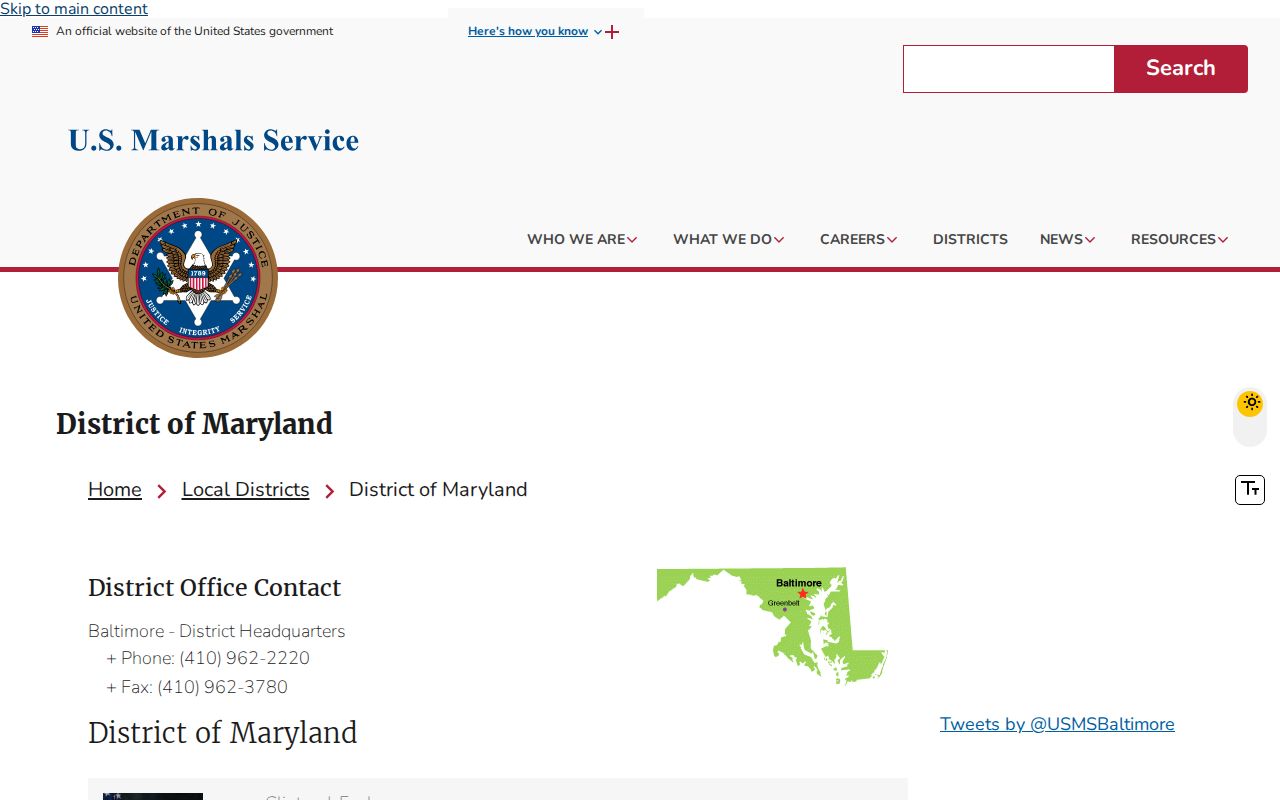
A federal fugitive profile asks for information. It is not confirmation from the listed agency. Never infer a booking date, custody location, or state-court outcome from a federal notice.
County Busted Notices and Sheriff Lists
A curated wanted page and a jail roster answer different questions. One tracks people authorities seek. The other shows who is in custody. A sheriff might run an active-warrant page while the detention portal lists bookings separately, and city police departments often post wanted notices for their own cases. Some counties link to a regional tip system or a statewide hub, while others show no current entries. An empty page proves nothing about local warrants.
Washington County shows the split. Its Sheriff's Office runs an inmate search and, separately, a Most Wanted Digest. Wicomico County does the same. Its Most Wanted page is separate. Someone can be absent from both public interfaces while another record exists, and a wanted entry can stay online after a status change. County sheriff websites are the starting point.
First identify where the warrant was issued or which agency is investigating, then use the Maryland county directory to reach that jurisdiction's official pages. Baltimore City is an independent city rather than a county, but its police and court records still come from the office handling the matter. Counties do not share one update schedule, eligibility rule, or tip reward.
A photo on a county list appears because the agency chose to publish it. The image may be an older booking photo, a driver's-license shot, an investigative picture, or another identification photo. Unless the page names its source, call it the agency's wanted photograph. Do not download it. Do not republish it as a current booking portrait.
Some systems route tips through Crime Solvers or another anonymous service. Rewards depend on local rules. The statewide MCAC number does not guarantee payment. Read the local instructions. Note whether the service takes calls, web forms, or texts, and follow its anonymity directions.
How to Report a Maryland Wanted Lead
Send information about a notice to the contact the official page names. MCAC routes non-emergency tips to 800-492-TIPS. Federal fugitives tied to Maryland go through the U.S. Marshals Service District of Maryland. Its 24-hour tip number is 1-888-869-4589. Use 911 for an immediate threat. Do not confront the person. Never try to verify a lead by following someone the notice names.
- Open the original notice. Follow the MCAC link to the responsible agency or use the county/police department’s official site. Check the page date, agency name, case reference, and tip method. A search-engine snippet or repost may be old.
- Compare the identifying details carefully. Names can be shared, descriptions can be broad, and photos can be dated. Do not decide that someone is the listed person based on resemblance alone. Tell the official recipient what you observed and where.
- Use the listed secure contact route. Call MCAC’s statewide tip line at 800-492-TIPS for non-emergency information or the agency’s own line. For a federal notice, use the USMS District of Maryland number 1-888-869-4589. If the notice directs information to another participating agency, follow its instruction.
- Give facts, not conclusions. Include the notice or case identifier, the time and location you observed something, and a concise description of what happened. Do not investigate, trespass, confront, or post a person’s suspected location publicly.
- Ask about anonymity or rewards before sharing details. The receiving program sets the terms. A tip line may not accept anonymous tips in every channel, and no reward is automatic. Keep any confirmation number the agency provides.
Safety comes first. Never approach a person named in a notice. Call 911 for an immediate emergency, use the published non-emergency tip route for other information, and remember that a notice can be outdated or mistaken, leaving identity checks to law enforcement.
The Maryland wanted hub also sends emergencies to 911. Tips go to 800-492-TIPS. The split is practical, since an emergency dispatcher can send a response while a tip line routes information for evaluation. Never use a tip line to harass, threaten, expose, or confront anyone.
Maryland tip contacts
Statewide non-emergency tips go to MCAC at 800-492-TIPS. For a federal fugitive, USMS District of Maryland answers 1-888-869-4589 at any hour. Call 911 for immediate danger.
Busted Notice vs. a Specific Warrant Check
A curated wanted page holds selected notices. It never lists every open warrant. Absence proves nothing about whether a warrant exists. Age cuts the other way too, since an old notice does not prove a warrant still stands. Warrant records may sit with the issuing court, the law-enforcement agency, or another custodian, and public access varies with record type and case status.
For a specific person, start with the county or court tied to the case. Contact the clerk or agency through its official process. Ask whether the office can confirm a warrant and what identification it needs. Name-only searches are risky. They can return the wrong person. Maryland Case Search is a public docket summary tool, not an authoritative live warrant or custody check. It can omit sealed, expunged, juvenile, or restricted matters, and a docket event is not proof that a warrant remains executable.
Whether someone sits in state custody is a different question. DPSCS's Incarcerated Individual Locator answers that one. It covers current state custody and location, offers no public booking-photo field, and does not list every county detention or federal case. County detention centers are separate custodians. A person may be released, transferred, or held under another jurisdiction even when a search returns nothing.
These routes describe official notices. They are not a tool for judging another person. If your own warrant might be involved, contact the issuing court, a Maryland attorney, or the official agency directly for the right next step.
Maryland's court portal can help you locate a public case record. A docket is not a live dispatch feed. Treat it as a paper trail. The responsible clerk or agency can explain whether a record is available, whether the case sits in the right jurisdiction, and how to request confirmation. Do not lean on a stale listing.
A careful check for a specific person
Warrant types are not interchangeable in Maryland. An arrest warrant targets a person. A bench warrant usually stems from a missed court date. A search warrant covers property instead of custody. The court's own glossary of court terms spells out each category. For the live status of one warrant, only the issuing court can say for sure.
| Warrant type | General purpose | Useful boundary |
|---|---|---|
| Arrest warrant | A judicial order directing an officer to arrest the person named. | Confirm identity and current status with the issuing office. |
| Bench warrant | A court-issued process for a person’s arrest; Maryland Courts gives failure to appear as one example. | Ask the court handling the case how to address the matter; a public wanted list may not display it. |
| Search warrant | An order directing officers to search for and seize described property. | It is not a public custody listing or an arrest notice by itself. |
- Confirm the likely issuing county or court from an official notice or case document.
- Use the court’s public case tool for docket context, while noting that it does not establish present custody or active warrant status.
- Contact the issuing clerk or agency through its official phone number or in-person process to ask about current status and required identifying information.
- Use DPSCS, a county detention locator, BOP, or ICE only when the custody question matches that system’s stated scope; those tools do not replace a warrant confirmation.
- If the matter concerns your own legal exposure, speak with counsel before deciding how to respond. Do not rely on a third-party lookup or social-media post.
Clocks rarely match across systems. A court entry, a sheriff's notice, and a detention locator each get updated on their own schedule by different offices. When timing truly matters, ask the issuing custodian to confirm the current record and its update date.