
Are Maryland Mugshots Public?
The answer is a qualified yes. Maryland's Public Information Act defines a public record broadly, covering photographs and electronic files. Section 4-101 supplies that starting definition. It promises no automatic release of booking photos, though. A custodian must review the record and the law that governs it. A sheriff's office may hold the image, while a court clerk keeps the docket. The state prison locator answers a separate custody question.
The PIA also lets agencies withhold certain material. Limits reach law-enforcement investigation files, intelligence and security records, and items where privacy, safety, or a fair trial is at stake. Section 4-351 spells out these law-enforcement restrictions. Some exceptions bind the custodian outright. Others call for weighing public access against a protected interest. Ask the agency that keeps the record, then read its reply and the legal basis it gives.
Maryland's Mugshot Law in Practice
Maryland Commercial Law §14-1324 targets a specific practice. It covers a commercial website operator that charges a fee to take down an arrest or detention photograph. The photo must stem from a criminal or traffic charge, or a suspected violation. The person must also have cleared a legal hurdle. Qualifying outcomes include expungement of the court or police record, a court order shielding that record, or a vacated judgment. The request goes by certified mail. Secure email works too when offered, with an electronic postmark. The current text of §14-1324 demands removal within 30 days. Written confirmation must follow within five business days. No removal fee is allowed. Breaking the rule counts as an unfair or deceptive trade practice.
Keep the rule's limits in view. It does not ban accurate booking images outright. It forces no agency to release a photo. Nor does it create an on-demand right to erase public records. A dismissal or acquittal alone does not compel deletion. The exact court result and the statute's conditions both matter.
Why Maryland Passed §14-1324
The law has a clear origin. In 2015 the General Assembly passed House Bill 744. Lawmakers had been hearing about commercial sites charging people to pull their arrest photos down. The bill took effect October 1, 2015. It framed a covered paid-removal demand as an unfair or deceptive trade practice. The official House Bill 744 record details the measure's purpose and scope.
That history explains the law's shape. It is no statewide ban on publishing booking images. Instead it targets a removal fee tied to a qualifying court outcome. Other routes exist apart from the statute. A public-records request, a court petition, an agency correction, an editorial ask, and a private site's form all work differently. Each one changes a different record or copy.
The statute's text is the best starting point for any request. Unsure whether an order qualifies? Ask the court clerk for a copy. A Maryland attorney can also advise on a specific case.
Request a Maryland Booking Photo
A live roster shows current custody only. Someone released from a county jail drops off the list. The booking record itself still sits in agency files. Maryland's PIA lets you ask a public agency for an existing record. Which office holds it depends on who made the arrest. County detention centers and police departments are the usual first stop for a booking image. DPSCS keeps state-level records, not each county's file.
A focused request gets faster results. The Maryland Department of Public Safety and Correctional Services asks requesters to be specific. Its PIA page notes the first two hours of search and preparation are free. Beyond that, costs can mount. Direct search time, legal review, and copies all add fees. Copying runs $0.50 per page. Certification or special handling may add more. County fee rules vary.
- Name the record. Ask for the booking photograph, intake sheet, or booking record, rather than a new statewide list or a summary that the agency does not keep.
- Identify the event. Give the person's name as known, county, booking date or range, arresting or intake agency, and booking number if available.
- State the format. Ask for an electronic copy if the agency keeps the record in that form. Note whether the request is for a photo, a record, or both.
- Send it to the holder. Follow the office's current PIA instructions. DPSCS lists dpscs.pia@maryland.gov for its requests; county and city requests go to the local custodian.
A custodian can still say no. The PIA permits redaction, and juvenile law, investigative exceptions, safety worries, and other statutes can also justify a denial. A proper denial names its legal basis. It should say whether part can still be released. There is no statewide posting rule. Agencies are not required to publish the same booking photo or leave it online for a fixed number of days.
The DPSCS page lays out the state request path, with its fee and scope notes, so review the current DPSCS PIA instructions before sending a state-level request.
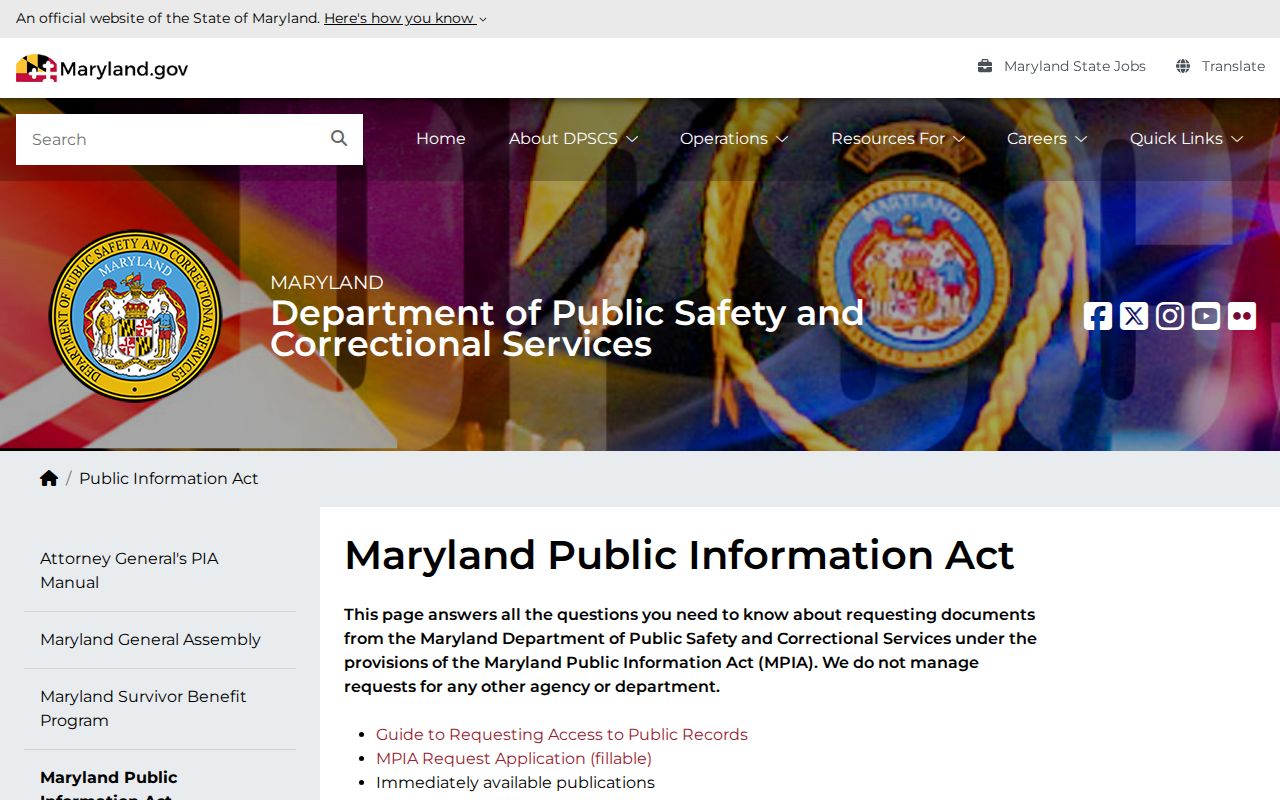
That state route stops at the records DPSCS holds. For a county booking photo, send the request straight to the county jail, sheriff, or police department that created or keeps the image.
Maryland Juvenile Booking Records
Juvenile records work under different rules in Maryland. Criminal Procedure Article §3-8A-27 treats them as confidential. Access usually needs a court order. The statute lets an agency release a child's name, address, photo, or other identifying details only in narrow public-safety situations, such as a missing or escaped child or certain arrest and warrant circumstances. It does not create a public juvenile booking feed. Read the juvenile-record statute before assuming an adult roster rule applies.
Case Search has its own limits. It warns that juvenile, shielded, expunged, and other confidential matters may not appear in public results. A blank search is not proof. The record may be protected, filed under a different name, or sitting in the wrong court. Sometimes no case was filed at all. The official Maryland Case Search is a court-record tool, not a complete statewide arrest index.
For an adult photo that is hard to find, request the existing image from its likely custodian. The Maryland statewide booking overview maps the county roster and feed routes. A court case has its own record. Use it for charges and disposition. Current state-prison custody is a separate lookup: the DPSCS offender search is a custody and location tool, not an offender-photo source.
Maryland Expungement and Shielding
Expungement strips eligible case information from public court and police access. It cannot reach every private copy. Eligibility and timing turn on the case outcome, the charge, the sentence, and later history. The current forms matter. Maryland Courts lists no filing fee for several outcomes, including acquittal, dismissal, probation before judgment (PBJ), nolle prosequi, stet, and not criminally responsible. Some guilty dispositions carry a $30 fee per case. A fee waiver exists when the person cannot pay. Cases that ended in acquittal, not guilty, dismissal, or nolle prosequi on or after October 1, 2021 are automatically expunged after three years, though a person can ask to file sooner. The Judiciary's current expungement instructions carry the forms and limits.
The 2025 Expungement Reform Act changed some of this. It took effect in stages, including October 1, 2025 and January 31, 2026, and it rewrote some waiting periods and eligible conviction categories. The law also directs the Judiciary to drop charges recorded as stet from Case Search after three years on the docket. Pardoned cannabis-possession convictions get attention too. A Case Search removal is not an expungement order for every police and court record. Read the enacted Chapter 95 text alongside those instructions.
Shielding is narrower. It hides a qualifying conviction from public view in Case Search and other public court access. It does not erase the conviction. Some authorized users can still see it. Maryland Courts describes a general three-year wait after the sentence ends, counting parole, probation, or mandatory supervision, and its list also bars certain crimes and conditions. The shielding rules should not be described as deletion of all copies.
A vacated judgment is a separate court result. After winning a qualifying expungement or shielding order, ask whether the booking agency has finished its own process. Keep a copy of the order. Section 14-1324 then supplies a separate, no-fee request path for a covered commercial operator. A court order changes the official public-record status. It does not rewrite an old newsroom story or every search result.
- Expungement
- Removal of eligible records from public inspection under a court process or an automatic rule.
- Shielding
- Limits public view of certain convictions while leaving the record in place for authorized access.
- Vacatur
- A court sets aside a judgment of conviction. The docket should show the order and any later action.
- Nolle prosequi
- The State's Attorney ends prosecution on a charge. It is a disposition, not a finding that the arrest record never existed.
- Stet
- The court places a charge on an inactive docket under conditions. It is not the same as a dismissal or an acquittal.
Free Mugshot Corrections in Maryland
The statute is one route, not a universal online eraser. A wrong-person image, false caption, stale charge, or changed case result needs a clear correction request. Send it to the source that published it. Include the page URL. Add the person's name as shown, plus the county and arrest date if known. Attach the court order or other proof. Keep a copy of what was sent. Each private operator runs its own review process. Its stated time is no guarantee that every copy will disappear.
| Source | Published free route | What the record supports |
|---|---|---|
| Busted Newspaper | No fee is listed; the form says review and removal may take five to ten days. | It asks for the listing URL and supporting records for outcomes such as expungement, dismissal, nolle prosequi, not guilty, or sealing. The estimate is the operator's statement, not a promise. |
| RecentlyBooked | The policy says requests are free and can seek removal or an update. | It lists expunged, dismissed, or sealed cases, incorrect or stale details, wrong-person entries, juvenile entries, and duplicates. It says accurate current public records are not removed just on request. |
| Mugshots.com | The policy describes free removal or updates, with a review period of up to ten business days. | It asks for signed, legible court records for favorable outcomes and lists other stated reasons, such as a sealed record or identity theft. |
Sites like these offer unofficial copies. Their pages can lag behind events or miss details. To confirm what actually happened, go straight to the official source. Use a Maryland court record or the booking agency. WBAL-TV's archived Maryland mugshot feature is an editorial collection, not a current roster. If a caption is wrong or a court has since resolved the matter, send the official paperwork. Use the outlet's editorial contact route. One caution: Section 14-1324 does not force a news archive to erase its coverage.
A search engine index and the source page are two separate records. An old search result can linger after the source corrects or removes its copy. Fix the source first. The index update is a different request. Neither one can change the underlying court or agency file.
Note: The result on a roster, docket, news page, and aggregator can reflect a different update date, so compare each source with the court's current disposition.